
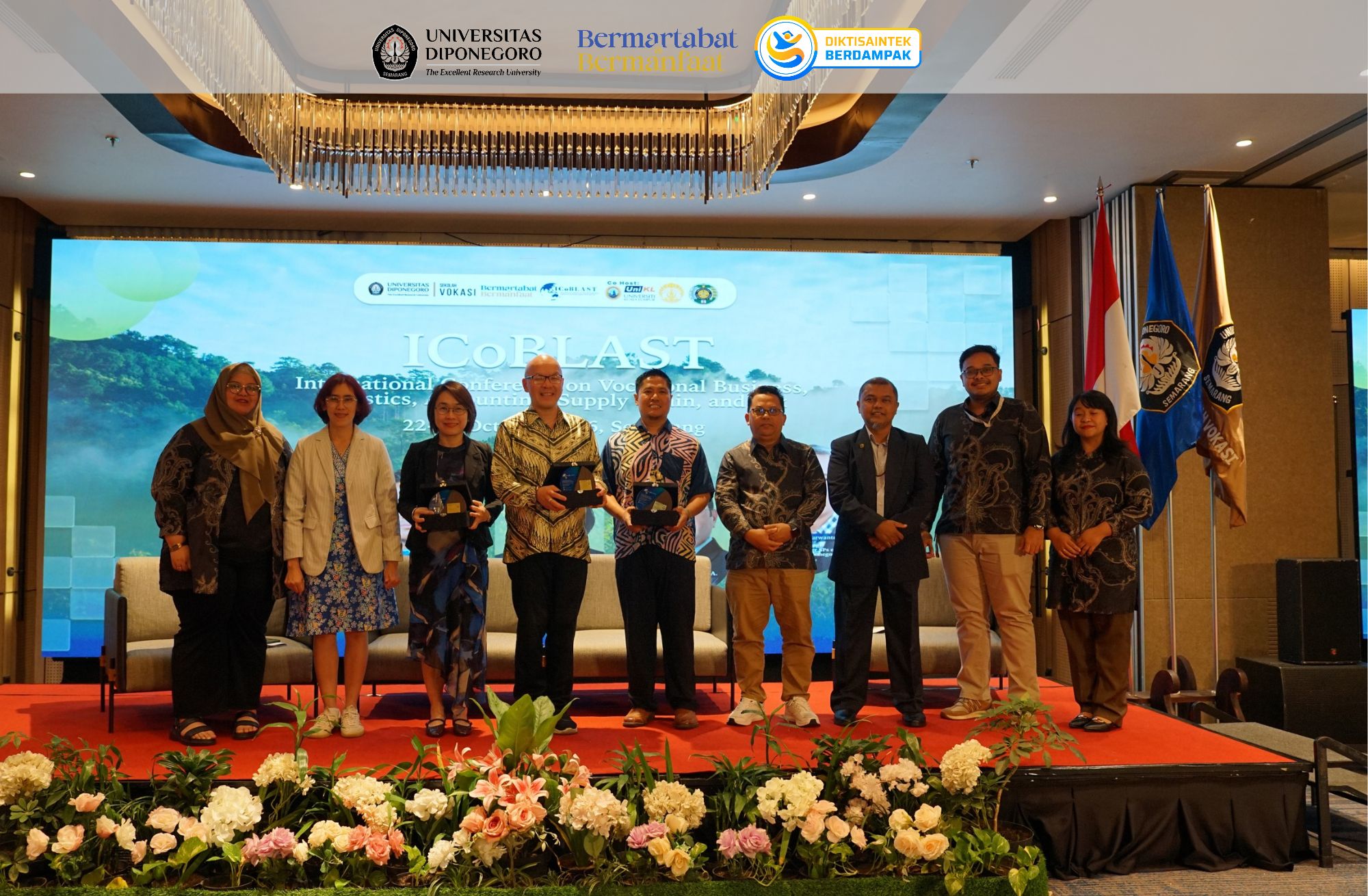
SEMARANG – International academic collaboration has become a strategic approach to addressing sustainability challenges in the business world. This commitment was reflected in The 2nd International Conference on Business, Logistics, Accounting, Supply Chain, and Tax (ICoBLAST) 2026, organized by the Department of Business and Finance, Vocational School of Universitas Diponegoro (UNDIP), on October 22–23, 2026, at Hotel Aruss Semarang. The conference was held in a hybrid format, welcoming both on-site and online participants, and was co-hosted by Universiti Kuala Lumpur, Universitas Indonesia, and Universitas Sumatera Utara.
Under the theme “Responsible Governance and Circular Innovation in Sustainable Business Ecosystems,” ICoBLAST 2026 provided a platform for exchanging ideas on the importance of responsible governance and circular innovation in fostering sustainable business ecosystems. Strategic issues across business, logistics, accounting, supply chain management, and taxation were explored to address evolving economic dynamics and increasingly complex social and environmental challenges.
The conference was attended by the Vice Rector IV of Universitas Diponegoro, Wijayanto, S.I.P., M.Si., Ph.D.; the Dean of the Vocational School of UNDIP, Prof. Dr. Ir. Budiyono, M.Si.; the Head of the Department of Business and Finance, Vocational School of UNDIP, Apip, S.E., M.Si.; as well as representatives from Bank Indonesia Central Java and the Central Java Regional Research and Innovation Agency (BRIDA).
Sustainability Requires Commitment and Concrete Action
The Chair of the ICoBLAST 2026 Organizing Committee, Naila Hanum, S.E., M.Acc., from the Tax Accounting Study Program, Vocational School of UNDIP, highlighted the importance of translating sustainability commitments into measurable and accountable actions.
In her opening remarks, she emphasized that a commitment to sustainability must be accompanied by appropriate policies, responsible decision-making, and concrete actions capable of addressing environmental and social challenges. She noted that statements of commitment and aspirations alone are insufficient to bring about meaningful change.
“How can we speak of sustainable business if our governance, policies, and innovations have yet to adequately address the environmental challenges before us? Sustainability, therefore, must extend beyond commitments and aspirations. It requires accountability, responsible decisions, and meaningful action,” she stated.
Naila also explained that this year’s conference featured approximately 60 research papers presented across several thematic tracks. The conference brought together authors, Scientific Committee members, and speakers from seven countries: Indonesia, Australia, Malaysia, Brunei Darussalam, Thailand, New Zealand, and France. This international participation enriched the exchange of perspectives while strengthening academic networks across borders.
Cross-Border Collaboration Expands Academic Opportunities
The commitment to strengthening international partnerships was also highlighted by Dr. Azlina binti Mohd Ali, Head of Aviation Management at Universiti Kuala Lumpur Malaysian Institute of Aviation Technology (UniKL MIAT), who represented one of the co-host institutions at ICoBLAST 2026.
Azlina expressed her appreciation for the opportunity for UniKL to participate in organizing the conference. She emphasized that bringing together academics from diverse disciplines and countries provides an important opportunity to strengthen relationships between higher education institutions and industry.
She also expressed her hope that the partnership between UNDIP and UniKL would continue to grow through strategic initiatives, including collaborative research, joint publications, academic mobility, and other programs that support the development of sustainable business ecosystems.
UNDIP Encourages Academic Research to Deliver Real-World Solutions
The Vice Rector IV of UNDIP, Wijayanto, S.I.P., M.Si., Ph.D., officially opened ICoBLAST 2026. In his address, he emphasized the importance of transparent governance, responsible decision-making, and innovation that considers long-term sustainability.
He noted that environmental challenges and economic uncertainty cannot be addressed effectively through approaches limited to a single institution or country. Instead, collaboration is needed to facilitate the exchange of experiences, bring research findings together, and develop approaches that respond to real-world needs.
He also reminded participants that UNDIP’s values of Noble and Valuable should be reflected in meaningful contributions to society. Knowledge and theories developed within universities, he explained, must extend beyond academic settings and help address the challenges faced by communities.
“Our knowledge and theories should not end on paper. They must find real solutions to real problems,” he emphasized.
His message underscored the importance of connecting research and scientific development with practical applications, enabling academic achievements to generate added value for society and the business community.
Five Keynote Speakers Explore Diverse Perspectives on Sustainability
Over the two-day conference, ICoBLAST 2026 featured five keynote speakers who examined sustainability from a range of perspectives. On the first day, the conference welcomed Prof. Dr. Irene Ting Wei Kiong from Universiti Malaysia Pahang Al-Sultan Abdullah (UMPSA), Assoc. Prof. Ferry Jie, Ph.D., from Edith Cowan University, Australia, and Assoc. Prof. Dr. Abu H. Ayob from Universiti Kebangsaan Malaysia (UKM).
Their presentations explored the relationship between Environmental, Social, and Governance (ESG) factors and corporate performance, sustainable supply chain development in the Society 5.0 era, and the application of green innovation to strengthen organizational competitiveness.
These perspectives enriched discussions on integrating sustainability principles into business strategies, operational systems, and decision-making processes. Sustainability was therefore presented not merely as an environmental agenda, but also as an integral part of organizational strategies for adapting to change and maintaining competitiveness.
Circular Economy and Green Industry Take Center Stage on Day Two
On the second day, Friday, October 23, 2026, discussions focused on industrial transformation through innovation and the advancement of sustainable development. Two keynote speakers explored approaches that place resource efficiency, waste reduction, and inclusive industrial development at the center of the transition toward a circular economy.
Prof. Dr. Ir. Purwanto, DEA, delivered a presentation entitled “Redefining Industrial Value: Innovative Pathways to a Zero-Waste Circular Economy.” His presentation examined how industrial value can be redefined through innovative approaches that support a zero-waste circular economy. This concept promotes more efficient resource utilization, reduced production waste, and the continued use of materials and products to preserve their economic value for as long as possible.
Meanwhile, Salil Dutt, M.Tech., MBA, from the United Nations Industrial Development Organization (UNIDO), presented “From Green Industries to Circular Economies: Accelerating Inclusive and Sustainable Industrial Development.” His presentation highlighted the role of green industries and circular economy practices in accelerating industrial transformation that prioritizes not only economic growth but also inclusivity and sustainability.
Together, these presentations broadened the discussion on how industrial innovation can foster more responsible production processes, optimize resource utilization, and support sustainable economic development.
Expanding Academic Networks for Lasting Impact
Through ICoBLAST 2026, the Department of Business and Finance at the Vocational School of UNDIP reinforced its role in facilitating knowledge exchange and advancing international collaboration in business, logistics, accounting, supply chain management, and taxation.
The conference served not only as a platform for academics to present their research findings but also as an opportunity to develop collaborative research initiatives, joint scholarly publications, and vocational education programs that are responsive to industry needs and global developments.
The partnerships established through the conference are expected to lead to initiatives that deliver long-term benefits. By bringing together academic insights and institutional experiences from different countries, ICoBLAST 2026 promotes the development of relevant, practical, and solution-oriented knowledge.
Ultimately, ICoBLAST 2026 represents an important step toward building business ecosystems grounded in responsible governance, innovation, and circular economy principles. Through interdisciplinary and international collaboration, the conference is expected to encourage more inclusive and sustainable business practices while generating tangible impacts and meaningful benefits for society, the business sector, and the environment.